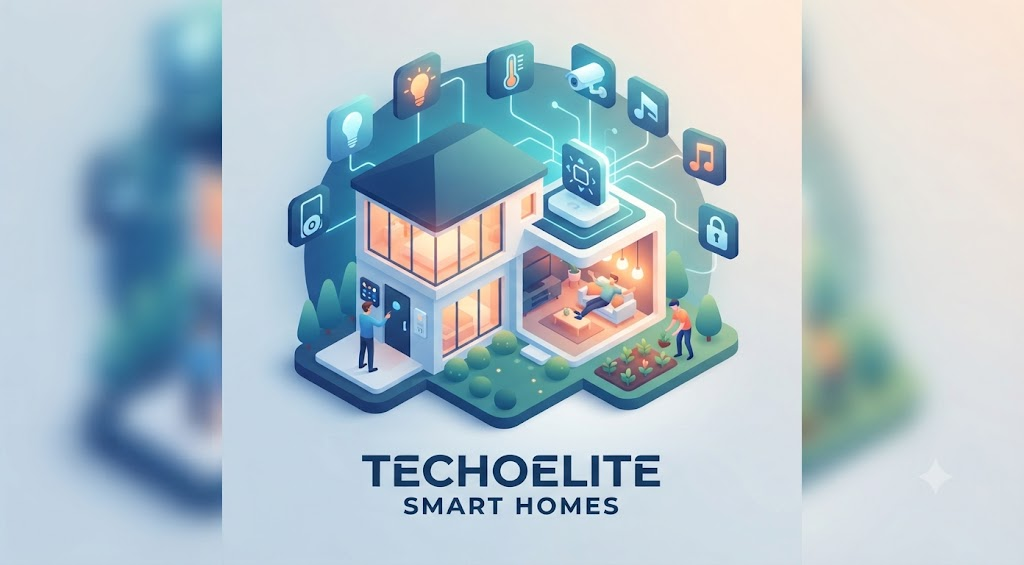
Most articles about techoelite smart homes read like they were written by someone who has never actually set foot in one. They talk about “seamless ecosystems” and “holistic living experiences” without ever telling you which device to buy, how much it costs, or what happens when your Wi-Fi goes down at 2 a.m. and your smart lock stops responding.
This guide is different. It is written for US homeowners and renters who want honest answers — not a sales pitch.
What “Techoelite Smart Home” Actually Means
Let us clear this up immediately. Techoelite is not a manufacturer. There is no Techoelite factory producing smart locks or thermostats. The term techoelite smart homes refers to a category — a premium, fully integrated approach to home automation where every device works together through a single ecosystem rather than operating as isolated gadgets.
Think of it this way: buying a smart bulb from one brand, a thermostat from another, and a camera from a third without checking compatibility is the opposite of a techoelite smart home. A true techoelite setup means every device communicates, every routine is automated, and you manage everything from one app or one voice command.
That distinction matters before you spend a single dollar.
Who Smart Homes Are Actually For (And Who Should Wait)
Before jumping into devices and ecosystems, be honest with yourself about your situation.
A smart home setup makes sense if you:
- Own your home or have a landlord who allows permanent device installation
- Have a stable, fast internet connection (minimum 100 Mbps recommended for full automation)
- Are willing to spend 3–5 hours setting up and troubleshooting in the first month
- Have a household budget of at least $500 to start meaningfully
You should probably wait if you:
- Move every 12–18 months
- Have unreliable internet or poor router placement
- Expect everything to work perfectly out of the box with zero configuration
- Are hoping to spend under $150 and get a full system
This is the conversation no other guide about techoelite smart homes has with you. Smart homes require investment — in time, money, and patience.
The 5 Core Systems Every Techoelite Smart Home Needs
A fully functional techoelite smart home is built on five pillars. You do not need all five on day one, but your long-term plan should include each one. techoelite, Scookiegeek, lcfmodgeeks.
Smart Security
Security is consistently the number one reason US homeowners adopt smart home technology. A solid security setup in 2026 includes:
- Video doorbell — Ring Video Doorbell 4 or Google Nest Doorbell
- Indoor/outdoor cameras — Arlo Pro 5S or Wyze Cam v4 (budget option)
- Smart locks — Schlage Encode Plus or August Wi-Fi Smart Lock
- Motion sensors — Samsung SmartThings or Aeotec
- Window/door sensors — Simplisafe or Ring Alarm sensors
The biggest mistake buyers make: purchasing cameras that only record to a proprietary cloud with no local backup. Always check whether your camera supports local storage via SD card or NAS device. If the company’s servers go down or they shut down, your footage disappears.
Smart Lighting
Lighting is the easiest and cheapest entry point for any techoelite smart home setup. It is also where most people waste money on the wrong products. how to use uhoebeans software
| Product | Best For | Price Range | Protocol |
|---|---|---|---|
| Philips Hue Starter Kit | Full color + scene control | $80–$180 | Zigbee / Matter |
| Lutron Caséta | In-wall dimmer switches | $60–$90/switch | Proprietary (Clear Connect) |
| LIFX A19 Bulbs | No hub, Wi-Fi direct | $30–$45/bulb | Wi-Fi |
| Govee Smart Bulbs | Budget color lighting | $10–$20/bulb | Wi-Fi / BLE |
One rule: if you want reliability, go with Lutron or Philips Hue. If you want affordability and can tolerate occasional reconnection issues, Govee and LIFX work fine for most rooms.
Climate Control
A smart thermostat pays for itself. US households spend an average of $900–$1,200 per year on heating and cooling. A properly configured smart thermostat typically reduces that by 15–23%.
Top picks:
- Google Nest Learning Thermostat — Learns your schedule automatically, works with Google Home
- Ecobee Smart Thermostat Premium — Includes room sensors, works with all three major ecosystems
- Honeywell Home T9 — Best for multi-zone homes
Do not buy a smart thermostat if your HVAC system is more than 20 years old without consulting an HVAC technician first. Compatibility issues are common and can result in system damage.
Entertainment Integration
This is the most overrated pillar and the least essential. A techoelite smart home does not require a $5,000 whole-home audio system. A practical entertainment setup includes:
- Smart TV with built-in Google TV or Apple TV 4K
- Smart speaker in main living areas (Amazon Echo Studio or Sonos Era 100)
- Smart universal remote (Logitech Harmony or SwitchBot Hub 2) to control legacy devices
The key is consolidating control. You should never need more than one remote or one app to run your entertainment system.
Energy Management
This is the most underbuilt pillar in most US smart homes. Beyond the thermostat, a full energy management setup includes:
- Smart plugs — Kasa EP25 or TP-Link Tapo P115 (track real-time energy usage per outlet)
- Smart power strips — Eliminates standby drain from TV setups and home offices
- Solar + battery monitoring — Enphase or SolarEdge systems for homeowners with solar panels
- EV charger integration — Wallbox Pulsar Plus or ChargePoint Home Flex for electric vehicle owners
Choosing Your Ecosystem: Alexa vs. Google Home vs. Apple HomeKit
This is the single most important decision you will make for your techoelite smart home. Getting this wrong means buying devices that do not talk to each other.
| Factor | Amazon Alexa | Google Home | Apple HomeKit |
|---|---|---|---|
| Device compatibility | Widest selection | Strong selection | More limited |
| Voice assistant quality | Good | Best for search queries | Best for Apple users |
| Privacy controls | Weakest | Moderate | Strongest |
| Automation flexibility | Strong | Strong | Good (getting better with Shortcuts) |
| Best for | Budget builders, renters | Android households | iPhone/iPad/Mac users |
| Hub required | Echo device | Nest Hub | HomePod or Apple TV |
Our recommendation for most US households: If your entire family uses Android phones, start with Google Home. If everyone has iPhones and you care about privacy, go Apple HomeKit. If you want maximum device selection at the lowest prices, Amazon Alexa wins on breadth.
The 2026 exception: Matter protocol is changing this rapidly. Matter-certified devices work across all three ecosystems. If a device is labeled “Matter compatible,” you are no longer locked into one ecosystem — a major shift for buyers in 2026.
Smart Home Protocols Explained
This is the section every techoelite smart home guide skips. It should not be skipped because protocol choice determines whether your devices will be reliable or frustrating.
Wi-Fi — Easiest to set up, works with every router. Problem: too many Wi-Fi devices overload your network and cause lag or dropouts. Not ideal for large installations.
Zigbee — Mesh network protocol. Devices extend the signal to each other. More reliable than Wi-Fi for large homes. Requires a hub (SmartThings, Philips Hue Bridge, or Aeotec Smart Home Hub).
Z-Wave — Similar to Zigbee but with longer range and less interference. Popular for security systems. Also requires a hub.
Thread — The next generation of mesh networking, lower power than Zigbee, designed for battery-powered devices. Requires a Thread Border Router (built into HomePod mini, Nest Hub Max, and newer Eero routers).
Matter — Not a wireless protocol. It is a universal software standard that lets devices from different brands work together regardless of whether they use Wi-Fi, Thread, or Ethernet.
Bottom line: For a starter setup under $1,000, Wi-Fi devices are fine. For a whole-home techoelite smart home with 20+ devices, invest in a Zigbee or Z-Wave hub and use Matter-certified devices wherever possible.
How Much Does a Techoelite Smart Home Cost? (3 Budget Tiers)
| Tier | Budget | What You Get |
|---|---|---|
| Starter | $300–$800 | Smart speaker, 4–6 bulbs, video doorbell, smart thermostat |
| Mid-Range | $1,500–$4,000 | Full lighting, 3–4 cameras, smart locks, thermostat, smart plugs, automation hub |
| Premium | $8,000–$25,000+ | Whole-home automation, professional installation, integrated AV, solar monitoring, custom scenes |
One thing no guide tells you: the cheapest part of a smart home is the hardware. The expensive part is your time. Plan for 1–3 hours per device category during initial setup.
Professional installation (hiring a smart home integrator) typically adds $1,500–$5,000 on top of hardware costs but is worth it for full whole-home setups.
DIY vs. Professional Installation
| DIY | Professional | |
|---|---|---|
| Cost | Hardware only | Hardware + $75–$150/hr labor |
| Time investment | High (yours) | Low (yours) |
| Customization | Moderate | Maximum |
| Reliability | Depends on your skill | Higher |
| Best for | Starter and mid-range setups | Premium whole-home systems |
If you are building a techoelite smart home in a new construction or doing a major renovation, hire a professional integrator. The wiring decisions made during construction determine your ceiling for automation capability permanently.
Smart Homes for Renters and Apartments
This audience is almost completely ignored by every article about techoelite smart homes. Here is the truth: you can build a solid smart home without drilling a single hole or modifying any permanent fixture.
Renter-friendly smart home stack:
- Smart plugs — Turn any outlet into a smart outlet, unplug and take them when you move
- Smart bulbs — Screw in, screw out. No wiring required
- Portable smart displays — Amazon Echo Show or Google Nest Hub as your control center
- Adhesive smart sensors — Door/window sensors that stick on without screws (Aqara, Eve)
- Smart locks — August Smart Lock Pro installs over your existing deadbolt without changing the lock itself (landlord-approved in most cases)
The one thing renters cannot easily do: smart light switches (requires wiring) and hardwired cameras. Work around those with battery-powered cameras and smart bulbs instead.
Privacy and Data Security: What Nobody Tells You
Every techoelite smart home guide talks about security cameras protecting your home. None of them talk about what happens to your camera footage after it is recorded.
Here is what you need to know:
- Most smart home cameras upload footage to company-owned cloud servers. That includes Amazon Ring, Google Nest, and Arlo.
- Ring has a documented history of sharing footage with law enforcement without homeowner notification (prior to 2023 policy changes). Review each brand’s current data-sharing policy before buying.
- Smart speakers like Echo and Google Home have active microphones that are always listening for wake words. Recordings are stored on company servers unless you manually delete them.
- Your smart home hub, if connected to the internet, is a potential entry point for hackers. Use a dedicated IoT VLAN on your router to isolate smart devices from computers and phones.
Minimum privacy steps for any techoelite smart home:
- Enable two-factor authentication on every smart home app
- Use a strong, unique password for your router and Wi-Fi network
- Choose cameras with local storage options as a backup
- Review and delete your voice assistant history monthly
- Keep all device firmware updated
Common Mistakes US Buyers Make
- Mixing ecosystems without checking Matter support — Leads to multiple apps and broken automations
- Underestimating router quality — A cheap router with 20+ connected devices will cause constant issues. Invest in a Wi-Fi 6 or Wi-Fi 6E mesh system (Eero Pro 6E or Orbi RBK863S)
- Automating everything at once — Start with three routines maximum. Add complexity gradually
- Ignoring battery maintenance — Smart sensors and locks run on batteries. Forgetting to replace them disables your automations silently
- Skipping the hub — Relying entirely on cloud-dependent Wi-Fi devices means your automation fails whenever the internet goes down. Local hubs (SmartThings, Hubitat) keep your home running offline
Frequently Asked Questions
What is a techoelite smart home in simple terms?
A techoelite smart home is a residence where lighting, security, climate, and appliances are connected and controlled together through one app, voice assistant, or automation system rather than operated manually or separately.
How many devices do I need to start?
A functional starter setup needs just four devices: a smart speaker, one smart thermostat, a video doorbell, and 2–3 smart bulbs. That gives you voice control, security awareness, and energy savings from day one.
Do smart homes work without internet?
Partially. Cloud-dependent devices like most cameras and Wi-Fi bulbs stop working. But local-hub-based systems (Hubitat, SmartThings with local processing) continue running automations even when your internet is down.
Which ecosystem is best for US households in 2026?
Google Home offers the best balance of voice intelligence, device compatibility, and Android integration. Apple HomeKit wins on privacy. Amazon Alexa wins on device selection and budget-friendly options.
Are techoelite smart homes worth the investment?
For homeowners planning to stay 5+ years, yes. Smart thermostats alone recover their cost in 12–18 months through energy savings. Security systems can lower home insurance premiums. And documented smart home features increase resale appeal in most US markets.
Can I build a smart home without hiring a professional?
Yes, for starter and mid-range setups. The majority of smart home devices sold in 2026 are designed for DIY installation. Professional installers are worth considering for whole-home systems, AV integration, or new construction where wiring decisions need to be made upfront.
What happens if a smart home company shuts down?
This is a legitimate risk. When Google shut down Stadia, users lost everything. The same risk exists with smart home platforms. To minimize this: choose devices that support Matter protocol, prioritize brands with long track records (Google, Amazon, Schlage, Lutron, Ecobee), and prefer devices with local processing over pure cloud dependency.