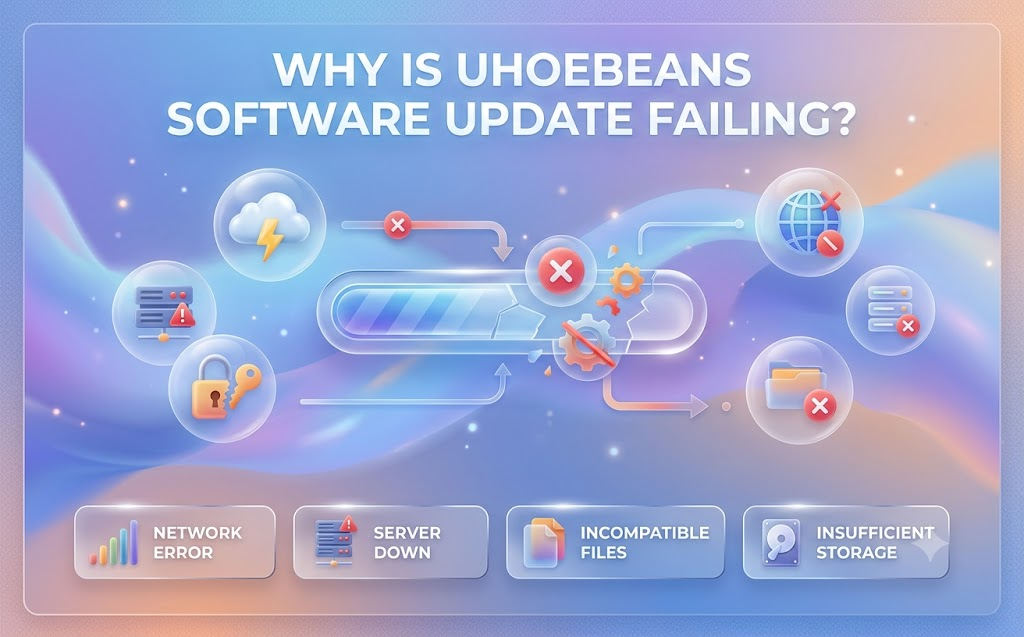
If you have ever clicked the update button on Uhoebeans and watched it freeze, loop, or throw a cryptic error message, you already know how disruptive this can be. Your team is waiting. Your workflows depend on the latest version. And the update simply refuses to finish.
This guide exists specifically for that moment. Unlike generic troubleshooting articles that recycle the same five bullet points, this one starts with a diagnosis — because why is Uhoebeans software update failing for you personally depends on exactly what you are seeing on your screen right now.
Before reading through causes and fixes, answer these three questions:
- Is your update showing an explicit error message, or is it just frozen?
- What percentage did the progress bar reach before stopping?
- Are you on a home Wi-Fi network or a corporate managed network?
Your answers determine which section applies to your situation. Jump there directly if you want, or read through for a complete picture of what is happening and why.
Failing vs. Slow: These Are Two Different Problems
Most articles lump “failing” and “slow” together. They should not. A slow update is a frustration. A failed update is a broken process that needs a specific fix.
A failed update looks like this:
- An explicit error message on screen (“Download failed,” “Verification failed,” “Installation could not complete”)
- The progress bar frozen at the same percentage for more than 15 minutes with no disk activity
- The update appears to finish, but the version number in your settings did not change
- Uhoebeans keeps prompting for the same update every time you open it (update loop)
A slow update looks like this:
- The progress bar is moving, even if barely
- No error message appears
- The application eventually finishes and restarts on the new version
If your situation matches the first list, you have a genuine failure. Keep reading. The next sections cover exactly why this happens and how to fix each specific scenario.
The Real Reasons Why Uhoebeans Software Update Failing Occurs
Understanding the root cause is the fastest path to the right fix. There are six primary failure categories, and identifying yours saves you from running through fixes that do not apply.
1. Unstable or Interrupted Internet Connection
Uhoebeans update packages carry changes across multiple integrated modules — project tracking, CRM, analytics, collaboration, and automation. That means each release is a large, complex file. Unlike streaming a video, which can buffer and recover from small drops, a software update requires a sustained, stable handshake between your device and the Uhoebeans update servers at every step.
Even brief Wi-Fi drops corrupt the package being downloaded. The installer then tries to work with a broken file and cannot verify the integrity of the update against its expected checksum. The result is a failure mid-installation or an error at the verification stage.
2. Insufficient Disk Space
| Free Space Available | What Happens During Update |
|---|---|
| 20% or more | Update installs smoothly |
| 10–19% | Update slows significantly, may stall |
| Below 10% | Installer bottlenecks, partial files corrupt |
| Under 5% | Update fails entirely, leaves broken temp files |
When storage runs low, the installer cannot unpack compressed files, store temporary working data, or create backups of components being replaced. In the worst cases, the update fails mid-process and leaves corrupted partial files behind — files that then block every future update attempt until they are manually removed.
3. Antivirus or Firewall Interference
Security software runs real-time scans on every file being downloaded and installed. Because update files are new and carry executable code, some antivirus tools flag them as suspicious before verifying they are safe. The update gets quarantined mid-installation without any visible notification to the user. The progress bar simply stops.
Corporate firewalls introduce a second layer. If your device sits behind a managed network, the firewall may actively block communication between your device and the Uhoebeans update servers — not because the update is malicious, but because the server domain has not been whitelisted by your IT department.
4. Corrupted Partial Download from a Previous Attempt
If you have tried updating before and it failed, the incomplete download file may still be sitting in your temporary files folder. The next time you try, the installer picks up that broken file and attempts to work from it instead of downloading a clean copy. This creates a frustrating loop where the update fails at the same percentage every single time.
5. Operating System Compatibility Conflict
Uhoebeans regularly updates its minimum system requirements as it adds new modules and features. If your Windows installation has been postponing major feature updates, or your macOS version is more than two releases behind, the Uhoebeans installer may hit compatibility gaps during the file-writing phase. Old drivers compound this — they create friction when the installer tries to write new components to system directories.
6. Server-Side Issues During Peak Rollout Periods
When a new version launches, thousands of users hit the update button simultaneously. Server load spikes. Download speeds drop. Handshakes time out. The update fails not because of anything on your end, but because the delivery infrastructure is under stress. This typically resolves within a few hours and is confirmed by checking the official Uhoebeans status page or social channels.
Stuck at a Specific Percentage? Use This Diagnostic Table
This is the most practical section for users experiencing Uhoebeans software update failing at a specific point. Find your percentage and read the most likely cause and fastest fix.
| Progress Bar Position | Most Likely Cause | Fastest Fix |
|---|---|---|
| 0–10% (never starts) | Server issue or network blocked | Check Uhoebeans status page, disable VPN, retry |
| 11–25% | Download interrupted early | Switch to wired connection, clear temp files, restart |
| 26–50% | Corrupted download or low disk space | Delete partial download files, free 20%+ disk space |
| 51–80% | Antivirus quarantine or permission error | Pause antivirus, run installer as Administrator |
| 81–99% | Verification failure or session timeout | Force close, restart device, relaunch update |
| Shows 100% but old version | Silent installation failure | Download full installer manually from official site |
Step-by-Step Fixes by Operating System
Windows Fixes
Step 1 — Clear the corrupted partial download
Press Win + R, type %AppData%\Uhoebeans\Updates and press Enter. Delete every file in that folder. These are temporary download files. Removing them forces the installer to download a clean copy on the next attempt. why is uhoebeans software update so slow
Step 2 — Free up disk space
Open Settings → System → Storage → Temporary Files. Check all boxes and click Remove Files. Aim for at least 20% free space on your primary drive before retrying.
Step 3 — Run the installer with Administrator rights
Right-click the Uhoebeans application icon and select Run as Administrator. Many permission-related failures at the 50–80% range are resolved by this single step alone.
Step 4 — Temporarily pause antivirus
Open your antivirus dashboard and pause real-time protection for 30 minutes. Attempt the update immediately. Re-enable protection as soon as the update finishes or fails.
Step 5 — Download the manual installer
If the in-app auto-update continues to fail, go to the official Uhoebeans website, download the full standalone installer, and run it manually. This bypasses the auto-update mechanism entirely and overwrites the old version cleanly.
macOS Fixes
Step 1 — Clear the update cache
Open Finder → Go → Go to Folder, type ~/Library/Application Support/Uhoebeans/ and delete any folder named Cache or Updates. This removes partial downloads that may be corrupting subsequent attempts.
Step 2 — Free up disk space
Go to Apple Menu → System Settings → General → Storage. Use the built-in recommendations to remove large files and empty the Trash. Confirm at least 20% of your drive is free before retrying.
Step 3 — Check macOS compatibility
Go to Apple Menu → System Settings → General → Software Update. If macOS updates are pending, install them first. Uhoebeans updates are optimized for current OS versions, and compatibility gaps in older releases cause failures at the installation phase.
Step 4 — Disable Gatekeeper temporarily (advanced users only)
If you are installing a manually downloaded package and macOS is blocking it, open System Settings → Privacy & Security and scroll down to find the blocked installer. Click Open Anyway. Re-enable standard security settings after installation.
For IT Administrators on Corporate Networks
If your organization is experiencing Uhoebeans software update failing across multiple devices, the fix sits at the network level, not the device level.
Firewall Whitelisting
Your IT firewall may be blocking the Uhoebeans update server domains. Work with your network administrator to whitelist all Uhoebeans update and CDN server domains. Check the official Uhoebeans documentation for the current list of required domains and IP ranges.
Administrator Privileges for Managed Devices
On managed endpoints, the update installer requires local administrator rights to write files to protected directories. If users are running standard accounts, update pushes will fail at the installation phase. Use your MDM or Group Policy to grant temporary elevated rights during update windows, or push the update package centrally using your deployment tool.
Scheduled Off-Peak Update Windows
Coordinate updates for early morning hours when server load is minimal and internal network traffic is low. This reduces both server-side timeout failures and internal bandwidth contention that causes corrupted downloads.
The Monthly Prevention Checklist
Preventing Uhoebeans software update failing is easier than troubleshooting it under pressure. Build these habits into a monthly routine:
One week before a major Uhoebeans release:
- Check that your OS is fully updated on all devices that run Uhoebeans
- Confirm at least 20% free disk space across all endpoints
- Review firewall rules to confirm update server domains are not blocked
The night before updating:
- Close all applications and browser tabs
- Disconnect your VPN
- Run a disk cleanup to remove temporary files
- Confirm your internet connection is stable (run a speed test if uncertain)
During the update:
- Stay on the same network — do not switch from Wi-Fi to mobile hotspot mid-update
- Do not run large downloads, cloud syncs, or video streams simultaneously
- Do not force-close the application unless the progress bar has been genuinely frozen for 15+ minutes with no disk activity confirmed through Task Manager (Windows) or Activity Monitor (macOS)
When to Contact Uhoebeans Support (And What to Bring)
Escalating to support without preparation wastes time. If you have worked through the fixes above and the update is still failing, contact the Uhoebeans support team with the following information ready:
- Your current version number (visible in Settings → About)
- The version you are trying to update to
- Your operating system and exact OS version
- The exact error message as displayed on screen (screenshot preferred)
- The percentage at which the failure occurred
- Whether you are on a corporate or personal network
- Log files — on Windows, check
%AppData%\Uhoebeans\Logs; on macOS, check~/Library/Logs/Uhoebeans/
Providing this information upfront typically cuts support resolution time significantly, because the team can identify the failure category without back-and-forth clarification.
Frequently Asked Questions
Why does Uhoebeans software update keep failing at the same percentage every time?
This almost always means a corrupted partial download is cached on your device. Delete the files in your Uhoebeans Updates temp folder and retry — the installer will download a clean copy.
Is it safe to use Uhoebeans while the update is failing?
You can continue using the current version, but leaving a failed update unresolved exposes your system to security vulnerabilities and compatibility issues that worsen over time.
Why is Uhoebeans software update failing only on my corporate device?
Your organization’s firewall is likely blocking the Uhoebeans update server domains. Contact your IT department and ask them to whitelist the update server addresses listed in Uhoebeans documentation.
Can I skip a failed Uhoebeans update and wait for the next one?
Skipping updates is not recommended. Each release includes security patches, and an unresolved failed update can leave corrupted files that cause the next update to fail as well.
How long should I wait before concluding the update is genuinely frozen?
Wait at least 15 minutes before concluding the update is truly stuck. Some verification stages appear frozen but are actively working. Confirm by checking disk read/write activity in Task Manager or Activity Monitor — if there is none after 15 minutes, the update has stalled.
Why is Uhoebeans software update failing only during business hours?
Peak-hour server congestion is the most likely cause. Thousands of users updating simultaneously overloads delivery servers. Schedule your update for early morning or late evening to avoid this window.
Does reinstalling Uhoebeans fix a failed update?
Yes, in persistent cases. Download the full installer from the official Uhoebeans website and run it as a clean install. This bypasses the auto-update mechanism and resolves most stubborn failure scenarios.
Why is Uhoebeans software update failing after my antivirus flagged it?
Your antivirus quarantined a file mid-installation. Check your antivirus quarantine folder, restore the flagged file if it is verified as safe, then pause real-time protection temporarily and retry the update from the beginning.
The Bottom Line
When Uhoebeans software update failing happens, the problem is almost never the software itself. It is a combination of environmental factors — your network stability, available disk space, antivirus behavior, OS compatibility, or cached partial files from a previous attempt. Each of these has a direct, testable fix.
Start with the diagnostic table. Match your frozen percentage to the most likely cause. Apply the OS-specific fix that matches your device. If the problem persists after two full attempts, download the manual installer from the official site and bypass the auto-update system entirely.
For enterprise teams, address the problem at the network level. Firewall rules and administrator privileges resolve the majority of corporate deployment failures before they reach individual users.
Staying updated is not optional — it is the foundation of software security and performance. With the approach outlined here, you can get through the process faster, reduce repeat failures, and keep your team running without unnecessary downtime.