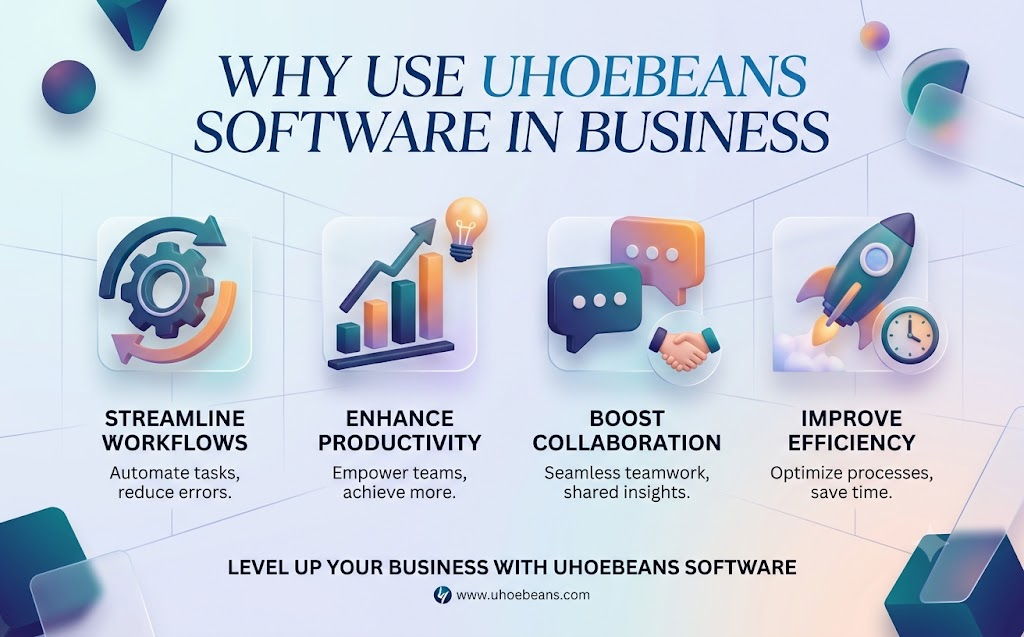
If you are running a small or mid-sized business in the United States right now, there is a good chance you are paying for at least four or five separate software tools — one for project management, one for CRM, another for reporting, maybe a chat app on top of that. The monthly bills add up. The context-switching kills productivity. And when data lives in five different places, someone always ends up making a decision based on outdated numbers.
This is exactly the problem that platforms like Uhoebeans are built to solve. But unlike every other article you will find on this topic, this guide is not here to sell you on anything. It is here to help you decide — clearly and honestly — whether why use Uhoebeans software in business is even the right question for your company, or whether a different tool would serve you better.
Let us get into it.
What Is Uhoebeans Software, Really?
Uhoebeans is an all-in-one business management platform designed to consolidate core operations — project management, CRM, financial tracking, team collaboration, and analytics — into a single centralized dashboard. Instead of bouncing between Asana, HubSpot, QuickBooks, and Slack, the idea is that your entire operational picture lives in one place.
The platform uses a modular architecture, meaning you activate only the features your business actually needs. A 12-person marketing agency does not have to deal with supply chain modules. A retail operation does not need to see legal workflow tools. This keeps the interface clean and reduces the learning curve significantly.
What Uhoebeans is not is a replacement for highly specialized tools. If your business requires deep, complex tax filings, dedicated accounting software like QuickBooks will still handle edge cases better. If your sales team lives inside Salesforce and has years of custom data built up, migration is a serious conversation, not a quick switch. Knowing this upfront saves you from disappointment later.

The Real Reasons Businesses Are Choosing This Platform
1. Operational Consolidation That Actually Saves Money
The average US small business spends between $500 and $2,000 per month on a fragmented stack of SaaS tools. When you consolidate four to six of those into a single subscription, the math shifts quickly in your favor — even before you factor in the productivity gains from not switching between platforms constantly.
Uhoebeans brings project management, customer data, financial reporting, and team communication under one roof. For a 15-person team running four separate paid tools, the consolidation alone can recover $600 to $900 per month in direct subscription costs.
2. Workflow Automation That Goes Beyond Basic Task Assignment
Every business management platform claims automation. What separates a useful automation engine from a checkbox feature is how deep it goes. With Uhoebeans, you can build multi-step triggers — for example, when a sales lead is marked as “Qualified,” the system automatically creates a follow-up task for the account manager, logs the interaction in the CRM, and updates the pipeline dashboard without anyone touching a keyboard.
For teams that previously handled this manually, eliminating even 90 minutes of daily administrative work per employee adds up to significant reclaimed capacity over a month.
3. Real-Time Data Without the Spreadsheet Nightmare
One of the most consistent pain points for growing US businesses is reporting. Someone builds a weekly spreadsheet on Monday, shares it Tuesday, and by Wednesday it is already wrong because three things changed. Uhoebeans pushes live data to a centralized dashboard, so when a manager pulls up performance metrics — sales figures, project completion rates, inventory levels — they are looking at what is actually happening right now, not what happened last Thursday.
This matters most during fast-moving decisions: a product launch, a hiring push, a sudden dip in customer retention. Leaders who have live data respond faster and make better calls.
4. Collaboration Built for Remote and Hybrid US Teams
The American workforce has normalized remote and hybrid work. Tools that require everyone to be in the same room — or even the same time zone — create friction. Uhoebeans provides shared task boards, in-platform communication threads, file sharing, and role-based access controls so that a team spread across New York, Austin, and Denver operates with the same clarity as a co-located one.
Role-based permissions are particularly useful here. A financial analyst sees budget dashboards. A project coordinator sees task boards and timelines. A sales rep sees their pipeline and customer notes. No one sees what they should not, and no one is buried in irrelevant information.
5. Scalability Without Re-Platforming
One of the most expensive and disruptive things a growing company can do is outgrow its software and migrate to a new system. The data cleanup, the retraining, the lost productivity — it is brutal. Uhoebeans is built modularly, so as your team grows from 10 to 50 to 150 people, you expand the platform rather than replace it. New departments get new modules. User seats are added without restructuring the entire system.
Who Should Use Uhoebeans Software in Business
Not every business is the right fit. Here is a straightforward breakdown:
Best fit:
- Businesses with 10 to 200 employees currently using 3 or more disconnected SaaS tools
- Operations-heavy teams in logistics, retail, professional services, or healthcare administration
- Companies with remote or hybrid teams that need centralized visibility
- Growing businesses that want to scale without re-platforming every two years
Probably not the right fit:
- Solo freelancers who only need basic task management (free tools like Notion or Trello are sufficient)
- Enterprises with deeply customized legacy ERP systems and dedicated IT departments
- Businesses whose entire workflow lives inside one specialized tool they have no reason to leave
Being honest about fit is something no competitor article bothers to do. It matters.

Uhoebeans vs. The Competition: An Honest Comparison
This is the table every other article avoids building. Here is how Uhoebeans stacks up against the platforms US businesses most commonly consider:
| Feature | Uhoebeans | ClickUp | Monday.com | Zoho One |
|---|---|---|---|---|
| All-in-one platform | ✅ Yes | Partial | Partial | ✅ Yes |
| Built-in CRM | ✅ Yes | Add-on | Add-on | ✅ Yes |
| Financial tracking | ✅ Yes | ❌ No | ❌ No | ✅ Yes |
| Modular architecture | ✅ Yes | ❌ No | ❌ No | Partial |
| Ease of onboarding | High | Medium | High | Low |
| US-based support | Verify directly | ✅ Yes | ✅ Yes | ✅ Yes |
| Starting price (approx.) | Verify on site | Free tier available | ~$9/user/mo | ~$37/user/mo |
| Best for | SMBs wanting consolidation | Task-heavy teams | Visual project managers | Large org suites |
Key takeaway: Zoho One is Uhoebeans’ closest structural competitor — both aim at all-in-one consolidation. The difference comes down to interface complexity and onboarding ease. Zoho One is powerful but notoriously steep to configure. Uhoebeans is designed to get teams operational faster.
ClickUp and Monday.com are excellent project management tools but they are not genuine all-in-one platforms. If you need CRM and financial visibility alongside project management, you will still need additional tools with those two — which defeats the consolidation goal.
Industry Use Cases: How US Businesses Are Applying It
Retail and E-Commerce
A retail operation running both physical and online channels juggles inventory levels, supplier orders, customer service tickets, and marketing campaigns simultaneously. Uhoebeans allows a retail manager to monitor stock levels triggering automated reorder alerts, track order fulfillment timelines, and review customer engagement data — all from one dashboard instead of logging into three separate systems.
Professional Services (Agencies, Consultancies, Law Firms)
For a 20-person marketing agency, project management and client communication are everything. Uhoebeans centralizes client project timelines, deliverable tracking, invoice generation, and team task assignment. When a client calls asking for a status update, the account manager pulls the live project board — not a manually updated spreadsheet — and answers in 30 seconds.
Healthcare Administration
Clinics and healthcare offices can use Uhoebeans to manage appointment scheduling, billing workflows, staff task assignments, and patient follow-up communications. It reduces the administrative burden on front-desk staff and gives practice managers a live operational picture. Note: for businesses subject to HIPAA requirements, always verify the platform’s specific compliance certifications before storing any patient data.
Logistics and Distribution
A mid-size logistics company tracking shipments, vendor relationships, and delivery team assignments across multiple routes benefits from Uhoebeans’ centralized data and automated workflow triggers. When a shipment status changes, the system can automatically notify the relevant team members and update the delivery dashboard without manual intervention. why is uhoebeans software update failing
ROI Framework: What Does This Actually Cost and Save?
Rather than vague claims about cost efficiency, here is a realistic worked example for a 15-person US business:
Current tool stack (hypothetical):
| Tool | Monthly Cost |
|---|---|
| Project management (ClickUp Pro) | $135 |
| CRM (HubSpot Starter) | $50 |
| Reporting/analytics tool | $80 |
| Team communication (add-on) | $45 |
| Total | $310/month |
If Uhoebeans consolidates all four functions at a lower combined subscription cost, the direct saving is immediate. Beyond subscriptions:
- Time savings: Eliminating 60 minutes per day of tool-switching and manual reporting for 15 employees = 375 hours per month reclaimed. At a $25/hour average labor cost, that is $9,375 in recovered productive time monthly.
- Error reduction: Automated data syncing reduces the manual entry errors that lead to misfiled invoices, missed follow-ups, and incorrect inventory counts — each of which carries its own downstream cost.
The ROI case is not hard to build. The key is being honest that it requires proper setup and adoption. A tool sitting unused delivers zero return.

Realistic Onboarding: What to Expect Week by Week
One thing competitors never cover is what implementation actually feels like. Here is a realistic timeline:
Week 1 — Setup and configuration Define user roles and permissions before adding any team members. Map your existing data fields carefully before migrating contacts, tasks, or financial records. Rushing this step causes automation errors downstream.
Week 2 — Data migration and integration Connect existing tools through available integrations. Test automation rules in a sandbox environment before relying on them in live operations. Do not migrate everything at once — start with the highest-priority function your team uses daily.
Week 3 — Team training Focus training on the dashboard layout and the two or three workflows your team will use 80% of the time. Avoid overwhelming staff with every feature on day one. Adoption is higher when people learn incrementally.
Week 4 — Review and adjust Pull analytics to see where the team is spending time, where automation is firing correctly, and where friction still exists. Adjust workflows based on real usage patterns, not assumptions made during setup.
Most teams reach comfortable operational fluency within 30 days when onboarding is approached this way.
Frequently Asked Questions
Is Uhoebeans software free to use?
Uhoebeans may offer a free trial or entry-level tier — check the official website for current US pricing, as plans and costs are updated regularly.
How does Uhoebeans compare to Monday.com for small businesses?
Monday.com excels at visual project management but lacks built-in CRM and financial tools, meaning small businesses still need additional software alongside it. Uhoebeans aims to cover all three in one platform.
Can Uhoebeans handle remote teams effectively?
Yes — shared dashboards, real-time task updates, file sharing, and role-based access are all designed to support distributed and hybrid teams without requiring co-location.
Is it difficult to migrate existing data into Uhoebeans?
Data migration requires careful field mapping upfront, but the process is manageable for most SMBs. The critical step is cleaning your existing data before importing rather than bringing over disorganized records.
Does Uhoebeans work for businesses outside of tech?
Absolutely. Retail, logistics, healthcare administration, and professional services are among the most common non-tech use cases, and the modular design allows each industry to activate only the relevant features.
How secure is business data on the platform?
Uhoebeans uses encryption protocols and role-based permissions to restrict data access. For businesses with specific compliance requirements such as HIPAA, verify the platform’s current certifications directly before storing sensitive information.
How many users can use Uhoebeans at once?
The platform is designed to scale from small teams to enterprise operations. Specific user limits depend on the subscription tier — review current plan details on the official site.
The Bottom Line
The question of why use Uhoebeans software in business comes down to one honest answer: if your team is currently duct-taping together four or more separate tools, paying for overlapping subscriptions, and losing time to manual reporting and context-switching, a consolidated platform makes both financial and operational sense.
Uhoebeans is not magic. It requires deliberate setup, a structured onboarding approach, and genuine team adoption to deliver its value. Businesses that treat it as a plug-and-play fix without investment in configuration will be disappointed — not because the platform fails, but because no software delivers results on autopilot.
But for a 10 to 150-person US business that takes implementation seriously, the combination of workflow automation, centralized data, real-time reporting, and tool consolidation creates a measurable operational advantage over competitors still running on scattered systems.
The best time to consolidate your tools was two years ago. The second best time is now.